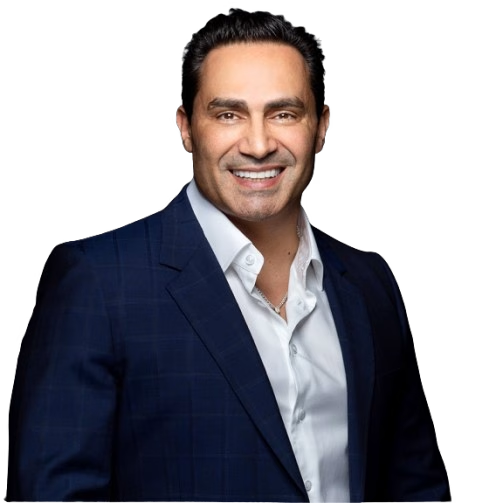
As a meticulous practitioner, Dr Dona consistently refines his surgical skills, maintaining a steadfast commitment to delivering excellence in Plastic Surgery.
Request a callback and one of our friendly staff will give you a call and discuss the procedure with you

Gynaecomastia is a condition in which males develop breast tissue. It can range from a small area of firmness beneath the nipple to fully developed breasts. Although it poses no physical risk, it commonly appears during puberty in otherwise healthy boys and often resolves on its own. In adults, Gynaecomastia can still occur and while many cases have no clear cause, several potential factors should be considered. These include lingering pubertal breast tissue, obesity, steroid use, hormonal disorders and certain medications.
Gynaecomastia can develop for several reasons and may involve an increase in glandular breast tissue, excess fatty tissue or a combination of both. The proportions vary from person to person. Because multiple factors can contribute to this condition, a detailed assessment with Dr Dona is essential to determine the underlying cause and the degree of tissue enlargement. This evaluation will guide the most appropriate surgical approach to achieve the optimal outcome.
Several factors need to be considered before proceeding with gynaecomastia surgery. During your consultation with Dr Dona, your general health will be reviewed to ensure you are suitable for surgery. The consultation will allow Dr Dona to assess your individual circumstances and discuss whether male breast reduction surgery may be an appropriate option for you.
Gynaecomastia itself is a benign enlargement of breast tissue in males. However, when assessing any breast change, it’s important to remain aware that male breast cancer, though uncommon, can occur. For this reason, further evaluation may be required. Dr Dona can provide an initial assessment, and if there are any concerns, he can refer you to the appropriate specialist for a more thorough assessment.
Signs that may require additional investigation include:
If you notice any of these symptoms, it’s important to consult your General Practitioner, who can provide a referral and guide you through the appropriate next steps.
During your initial consultation with Dr Dona, a comprehensive assessment will be carried out. This begins with a detailed medical history, followed by an examination of the chest to understand the extent and possible causes of your gynaecomastia. It is important to provide information about any current health conditions, symptoms, past or present medications and any other relevant medical details.
After the assessment, Dr Dona will outline the surgical options available. This discussion will include information about the procedure, possible scarring, the recovery process and potential risks or complications. You will also have the opportunity to ask any questions.
This consultation is an essential step in developing a surgical plan tailored to your specific circumstances.
If you are considering surgery for Gynaecomastia, there are several important factors to keep in mind:
Gynaecomastia surgery is usually performed as a day procedure, which means most patients can return home on the same day. In more extensive cases, an overnight hospital stay may be recommended. The type of surgery performed depends on the severity of the Gynaecomastia and the type of tissue involved.
When excess fatty tissue is the main cause of Gynaecomastia, Liposculpture may be an appropriate option. This technique involves creating one or two small incisions, each about five millimetres, near the treatment area. A thin tube called a cannula is inserted through these incisions to break down and remove unwanted fat from the chest. Liposculpture targets fatty tissue to reduce chest fullness and help define the chest shape. Dr Dona will often use this approach when the breast enlargement is caused mainly by fat and there is no significant excess skin.
When glandular tissue causes the enlargement or the Gynaecomastia is more advanced, surgical excision is usually recommended. The most common method uses a single incision along the lower border of the areola, which typically heals very well. This incision provides access for Dr Dona to remove excess glandular tissue and fat to create a flatter chest contour. If there is a significant amount of excess skin, additional incisions may be required to remove the extra skin and optimise the shape of the chest. In more severe cases, where the breast tissue is fully developed or hangs downward, a breast reduction pattern similar to that used in female Breast Reduction surgery may be necessary. In very large Gynaecomastia cases that require substantial tissue removal, the nipple and areola may need to be removed and grafted into a more suitable position.
Both Liposculpture and surgical excision effectively treat Gynaecomastia. The recommended approach depends on factors such as the type of tissue involved, the amount of skin excess and the overall severity of the condition. During your consultation, Dr Dona will assess your chest and outline the surgical options that may be suitable for your individual circumstances.
If your procedure is performed as a day case, it will take place at Kingsgrove Private Day Hospital. You will be discharged on the same day as your surgery. Your first heaLED postoperative appointment will take place the following day at our clinic. This appointment includes:
Some individuals may require an overnight stay following surgery. In these cases, you can choose to have your procedure at Norwest Private Hospital, located only minutes from our Bella Vista office, or at Westmead Private Hospital.You will usually be discharged the following morning. After discharge, you will return directly to our Bella Vista clinic for your first heaLED postoperative appointment. This visit includes:
Our clinical and nursing team will continue to support you throughout your postoperative journey.
If you are using prescription weight-loss medication such as a GLP-1 receptor agonist or a dual GLP-1/GIP agonist, you will generally be advised to continue taking it. You will need to follow a few important precautions before surgery to support your safety during anaesthesia. Further guidance is available on our Weight Loss Medications and Surgery Information page, where you will find clear instructions to help you prepare for your procedure.
Many patients travel from regional areas, interstate and overseas to see Dr Dona at our Bella Vista practice in Sydney. If you are planning to travel for Gynaecomastia surgery, we have put together information to help you prepare. This includes details about referrals, pre-operative appointments, local accommodation, transport options and postoperative support services. If you decide to proceed with Gynaecomastia surgery, you will need to stay in Sydney from a few days to a couple of weeks, following your operation. During this time, you will attend our clinic for regular healed post-operative appointments.
After you leave hospital and return to your accommodation, you will need to move carefully and avoid certain activities while your body heals. Tasks such as cooking, cleaning, personal care and driving can be difficult in the early stages. Because of this, you will require support from a family member, friend or a professional carer. If you do not have someone who can stay with you, external nursing services may be helpful. Some private health insurance policies provide rebates for postoperative home care, so it is worth checking with your fund to see what assistance you may be eligible for. Suggested providers include:
Specialist patient transport services can assist with travel between the hospital and our clinic for your postoperative appointments. Options include:
Recovery from Gynaecomastia Surgery can vary from person to person but there are general milestones and guidelines you can expect during the healing process. It’s important to note that you should follow Dr Dona’s specific post-operative instructions. Here are some common recovery milestones after Gynaecomastia Surgery:
Immediately following the procedure, you should be taken to a recovery area where your condition should be closely monitored until you awaken and stabilise. Most patients can return home on the same day as the procedure but be prepared to experience some pain, discomfort, swelling and bruising to the chest area. This is typically managed with prescribed pain relief medications and prophylactic antibiotics to protect you against infections and promote the healing process.
To assist with recovery and optimise results, a special surgical garment will be provided for you to wear for the first four to six weeks post-surgery.
Some individuals may notice visible scarring after Gynaecomastia surgery, especially if incisions are made around the areola or additional incisions are required to remove excess skin. Although our heaLED postoperative care program supports recovery, some degree of scarring is expected.
For those who would like to lessen the visibility of these scars, cosmetic camouflage tattooing may be an option. This technique places pigment into the scar tissue that closely matches the surrounding skin tone, helping the area blend more naturally with the rest of the chest. If your procedure involves incisions around the areola, tattooing can also help match the colour of the existing areolar pigment.
Most patients will need to wait at least 12 months after surgery before considering camouflage tattooing, as scars need time to fully mature. The aim of this treatment is to provide a subtle improvement in the appearance of scars.
All surgery carries potential risks that you need to be aware of. LEARN MORE
Gynaecomastia Surgery, like any surgical procedure, carries potential risks and complications. So, while complications are relatively rare, it’s essential to be aware of them.
In addition to these potential complications, patients should also be aware of the following considerations:
The cost of Gynaecomastia surgery can vary, as it depends on several factors, including the extent of the procedure and the surgical techniques required.
A consultation with Dr Dona is necessary to provide an accurate cost estimate. During this appointment, he will assess your condition, discuss suitable treatment options and provide a detailed outline of the fees involved. These may include surgical fees, anaesthesia, hospital or facility costs and any other associated charges.
If Gynaecomastia is causing physical discomfort or other medical issues, your Private Health Insurance, and or Medicare, may cover some of your overall surgery costs however, this can only be confirmed following your consultation with Dr Dona.
Medicare may contribute in cases that meet specific clinical criteria. A Medicare item number can only be confirmed after a consultation and assessment. Any rebate typically covers a small portion of overall surgical costs.
If a Medicare item number is applicable to your procedure, you may be able to use your private health insurance. Private health funds often contribute to hospital or theatre fees, although this varies between policies and usually requires payment of an excess. In most cases, only limited rebates are provided for the surgical fees themselves.
Some policies may also offer support for postoperative care, such as approved external nursing services. Once you have received any relevant Medicare item numbers at your consultation with Dr Dona, it is recommended that you contact your health fund directly to confirm your level of cover and any applicable benefits.