Excess Skin: The Byproduct of Massive Weight Loss
Thu 3rd Sep 2026
With the rising popularity of GLP-1s and bariatric surgery, more people than ever are experiencing significant or massive weight loss. While this is a feat worth celebrating, it also often comes with significant excess skin and stretched tissue. This can have far-reaching ramifications beyond aesthetics, with individuals often experiencing significant functional and medical issues that greatly impact daily life. This article breaks down the issues and discusses surgical options to address excess skin.
What is Massive Weight Loss?
The term ‘massive weight loss’ (MWL) is often used to describe substantial weight loss, particularly when it results in significant redundant or hanging skin. In plastic surgery literature, it has traditionally been defined as losing around 50 per cent or more of a person’s excess body weight. And today, due to GLP-1s and bariatric surgery, MWL is becoming more prevalent.
How Much Weight Can People Lose with GLP-1s or Bariatric Surgery?
Current data show that bariatric surgery causes people to lose more weight, and faster. However, while weight loss from GLP1-s is not as dramatic, it still delivers excellent results.
For example, clinical trials show that newer GLP-1-based medications can produce average weight losses of around 15–20% over approximately 1–1.5 years, depending on the medication and dose. Bariatric surgery generally produces greater weight loss, although the amount varies by procedure type and individual.
As an illustration, a 120 kg individual may lose the following:
- GLP-1s: 15 – 20% (18-24 kg)
- Bariatric surgery: 30% (36 kg)
While bariatric surgery produces greater weight loss than GLP-1-based medication, both methods can lead to significant weight loss. And this leaves the equally significant problem of excess skin.
Why Does Excess Skin Develop After MWL?
As you slowly gain weight, your skin stretches to accommodate your increasing volume. If this stretching is prolonged or substantial, it can affect the skin’s structural components, including collagen and elastin. This reduces its ability to recoil. Stretch marks (striae) may also develop when the skin stretches rapidly or significantly.
When you lose weight, this skin may not fully retract to fit your new, smaller frame. This can leave persistent folds of loose skin and stretch marks.
The Negative Effects Of Loose Skin
After massive weight loss, the negative effects of loose skin can be profound, both medically and functionally.
Medical Effects
Excess skin causes skin folds. This can then create a combination of friction, moisture and heat, resulting in the following medical issues:
Rashes and Irritation: When two skin surfaces rub together repeatedly, friction can cause inflammation, redness, soreness and sometimes broken or ulcerated skin. This is commonly called intertrigo and looks like a red, bumpy rash. It can also lead to an infection.
Fungal and Bacterial Infections: Deep skin folds can trap sweat and moisture, creating an environment where fungi such as Candida and bacteria can multiply, causing ongoing irritation and/or infections.
Persistent Sores and Ulceration: Repeated friction and moisture can cause skin breakdown, particularly where larger abdominal folds rest against the lower abdomen, pubic region or sides.
Functional Effects
Excess skin can affect an individual’s ability to move and perform everyday activities, with the main functional problems including:
Difficulty Walking: Large folds of skin, particularly around the abdomen and thighs, can interfere with normal movement and make walking uncomfortable.
Difficulty Exercising: Excess skin can rub, pull or move during physical activity, making exercise uncomfortable and sometimes limiting participation in sport or other activities.
Postural Problems: Large or heavy areas of redundant tissue (particularly in the abdomen) can affect posture.
Back, Neck or Shoulder Discomfort: The weight and distribution of excess tissue can contribute to musculoskeletal strain and aching, particularly where substantial tissue hangs from the trunk or lower body.
Difficulty Maintaining Personal Hygiene: Deep or overlapping skinfolds can make it difficult to wash and dry the skin properly between the folds.
Problems with Clothing: Large skinfolds make it difficult to find comfortable, well-fitting clothes, particularly if there is excess skin in the abdomen, thighs or arms.
Body Contouring Surgery After MWL
After massive weight loss, significant excess skin may remain in multiple areas of the body and may not retract sufficiently on its own. When this skin causes persistent functional or medical problems, surgery is the only way to remove the redundant skin itself.
Body Contouring surgery addresses the complex needs of individuals who have experienced massive weight loss. It comprises many surgical procedures, each tailored to the individual.
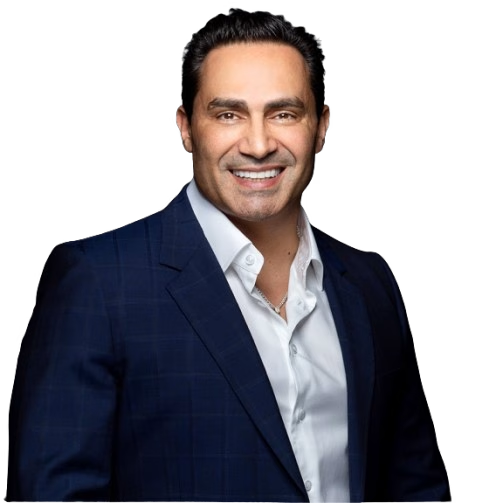
Dr Eddy Dona has a special interest in Body Contouring surgery and, over the years, has refined and developed techniques to address the varied needs of post-weight-loss patients. In doing so, he has defined ‘The 7 ‘B’s of Body Contouring Surgery. They are as follows:
- BRACHIOPLASTY (ARM LIFT): Removes excessive loose skin along the upper arm.
- BREAST SURGERY: Breast Reductions, Breast Lifts or Breast Augmentations.
- BRA LIPECTOMY: A Bra Lipectomy removes skin and tissues in the upper middle of the back around the bra strap area (bra rolls). This procedure is also called an Upper Body Lift, a Bra Line Back Lift or an Upper Truncoplasty.
- BELLY SURGERY (ABDOMINOPLASTY, A.K.A. TUMMY TUCK SURGERY): The type of Abdominoplasty Surgery required will be determined by the amount of excess skin and fat in the middle and lower abdominal wall.
- BELT LIPECTOMY: Removes excess fat and skin circumferentially, around the lower back, sides of waist and abdomen. It is effectively two combined operations — an Abdominoplasty and a Buttock Lift. It goes by several names, including 360 Tummy Tuck, Lower Body Lift, Total Body Lift and Lower Truncoplasty.
- BUTTOCK LIFT: Lifts and tightens the buttocks, removes excess skin from the lower back, and creates a more comfortable shape along your back and buttocks.
- BELOW THE WAISTLINE SURGERY: Tightening and altering the form of the inner thigh by removing excess skin and fatty tissue. This can also refer to surgery involving the mons pubis and genital region (e.g., Labiaplasty).
Creating Your Personalised Surgical Plan
If you’ve lost considerable weight, you likely have more than one area of your body that has been affected. That’s why patients often undergo several Body Contouring procedures. While it may be tempting to address everything surgically at once, this often isn’t possible. To determine what is clinically appropriate for you and the order of procedures, you will first need a consultation with Dr Dona.
During your initial consultation, Dr Dona will:
- listen to your concerns and objectives and learn how your excess skin is affecting you
- ask you about your desired outcomes
- carefully examine and assess the areas you’d like to address
- assess your medical history
- take measurements
- explain the surgical options he thinks are clinically suitable for you
- outline the cost involved in your procedures and any Medicare or Private health insurance rebates
- discuss the potential risks and complications
- explain the recovery period
Dr Dona will also create a surgical plan. This may involve a single surgery or a combination of surgeries performed at one time, such as a Tummy Tuck (Abdominoplasty) with a Breast Reduction (Reduction Mammoplasty). Whether you can combine procedures depends on several factors, including your health, medical history, lifestyle, work commitments and finances.
Many patients undergo Body Contouring surgery in stages. When procedures are performed separately, the minimum interval is generally around three months, although the appropriate timing depends on the individual’s healing, overall health and the procedures being performed.
Book an Initial Consultation With Dr Dona
If you’re concerned about excess skin and would like to discuss Body Contouring surgery, book an initial consultation with Dr Eddy Dona today.